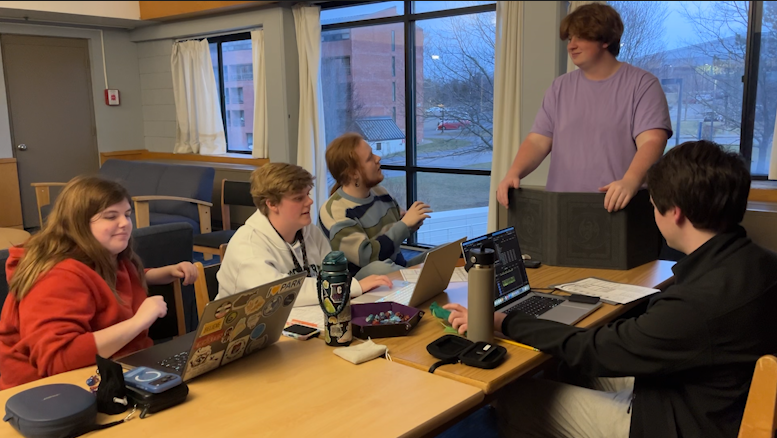
Dungeons & Dragons builds community
Dungeons & Dragons is one of the most popular tabletop games in the world. Dubbed the “World’s Greatest Roleplaying Game”, it recently celebrated its 50th anniversary. Now, with learning to play more accessible than ever before, players are beginning to see unexpected social benefits from a game long viewed as an obscure counter-culture icon.
Created in 1975 by Gary Gygax, Dungeons & Dragons was often seen as a niche interest, something that was played by only die-hard fantasy fans, who were almost exclusively straight, white men. For decades afterward, the game became a target of purity culture and the satanic panic movement. However, tabletop games grew in popularity throughout the 2010s, thanks in part to shows like Stranger Things, which pulls its famous demogorgons and mindflayers from D&D. The pandemic saw an explosion in its popularity, continuing into 2024 with the fastest-selling edition of its Player’s Handbook.
As most of the world was stuck inside, people began to learn to play the game, and many live-play podcasts, such as Critical Role and Dimension 20, saw massive increases in their viewership. Now, both shows have seen their fanbases explode dramatically, with Critical Role crowdfunding over $11 million for an Amazon Original show and Dimension 20 selling out a show at Madison Square Garden in New York City.
For many fans of both the shows and Dungeons & Dragons itself, though, the game represents a community that they couldn’t find elsewhere. Dawson Krause, a sophomore at Ithaca College who learned tabletop games from a family member and began playing D&D in 2020, said the first thing he did upon arriving at Ithaca was look for other D&D players.
“It’s been one of the biggest influences in my life,” Krause said. “Most of my friends that I have now are made through D&D. Obviously I had talked to them beforehand to get to know them, but where we really sealed our relationship was through D&D.”
Each session of D&D can be anywhere from a four- to six-hour commitment, with many groups choosing to meet in person to face off as a team against a variety of foes. Players create characters, choosing from twelve classes with their own skills and writing backstories, while one player takes on the role of ‘Dungeon Master’, guiding the group through an adventure. Studies have shown that, through engaging with each other and the story, players’ mental health can improve, as can their social and problem-solving skills.
Piper Davis, president of IC’s First Adventure club, said that she has witnessed many of these instances throughout her eight years playing TTRPGs.
“It’s really good at building community,” Davis said. As a whole, it’s really good at developing creative thinking and problem-solving. When I first started playing, I was a very socially awkward kid who didn’t really know how to hold a conversation, but through playing D&D ... I was really able to come into my own.”
With the game’s 50th anniversary, it seems to be showing no sign of slowing down. Wizards of the Coast, D&D’s publisher, logged $1.17 billion in annual revenue as of October 2024 and has loaned the D&D namesake to a movie, an off-Broadway play and an award-winning video game, Baldur’s Gate 3. The company recently overhauled the rules for the game’s fifth edition, inviting newer players with simpler and updated rules.
For the adventurers and their real-life counterparts, the journey will continue as the game continues to reinvent itself as a space in which members of any community can come together to tell a story greater than themselves.
Post a comment